

(back of elephants walking by Khunkay, CC BY-SA 3.0 https://creativecommons.org/licenses/by-sa/3.0, via Wikimedia Commons)
There was a time when three giant herbivore cousins; the African elephants, Asian elephants, and the Woolly Mammoths coexisted in our planet. As Ice Age was ending about four thousand years ago, the remaining furry ones among them which lived in the part of the world covered with ice, all died out. They were not just over hunted by people, the changing environment too shrunk their habitat and diminished their food source. Such a long time ago, but as to why they totally disappeared are just about the same reasons on why elephants in our present time might just vanish forever.
(number of elephants year 2025)
_-_Mauricio_Ant%C3%B3n.jpg)

_33.jpg)
Wooly mammoths by Mauricio Antón, CC BY 2.5 https://creativecommons.org/licenses/by/2.5, via Wikimedia Commons
African elephants walking by Dariusz Jemielniak (“Pundit”), CC BY-SA 4.0 https://creativecommons.org/licenses/by-sa/4.0, via Wikimedia Commons
Asian elephants walking by Drashokk, CC BY-SA 4.0 https://creativecommons.org/licenses/by-sa/4.0, via Wikimedia Commons
Can you imagine a world without elephants?

Mali was an Asian elephant who lived alone in a zoo for forty years. People flock to see her, majestic, huge and gentle. It was a great loss for the zoo when she died yet to keep any animal, in a solitary and unnatural condition, no matter how much attention and care is given, is still short of solicitude. (How much worse for neglected captive ones like those from roadside zoos) Elephants are social animals, they live in groups, much like a closely knit human family. They hold reunion on a fixed time and place, greet each other, they love to socialize and play together. Elephants are not meant to live alone.
Mali by Wolfgang Hägele, CC BY-SA 4.0 https://creativecommons.org/licenses/by-sa/4.0, via Wikimedia Commons
Look at an elephant’s eye,


An elephant’s eye by Alexander Klink CC BY 3.0 https://creativecommons.org/licenses/by/3.0, via Wikimedia Commons
A human’s eye by Elyzhium, CC BY-SA 3.0 https://creativecommons.org/licenses/by-sa/3.0, via Wikimedia Commons
To hear its story
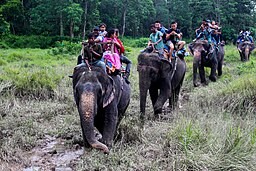
Riding an elephant is an adventure to some people, but to elephants, it is debilitating. Carrying weights is painful and make damage to their spines and health. The only reason it can happen is because they were forced to do so, trained in the only possible, cruel way.

←elephants’ sharp backbones pointing upward, meant to support its own weight, would hurt when pressed with loads.
a horse’s sturdy musculoskeletal system can sustain pressure

For an elephant to do tricks in a circus like sit on a stool

elephant sitting on a stool – Columbus Metropolitan Library, Public domain, via Wikimedia Commons from Aladdin shrine circus
paint art

elephant painting art by Raki_Man, CC BY 3.0 https://creativecommons.org/licenses/by/3.0, via Wikimedia Commons
work in logging

elephant logger by Chinchu.c, CC BY-SA 4.0 https://creativecommons.org/licenses/by-sa/4.0, via Wikimedia Commons
to carry people in tourism or entertainment
_(4381215477).jpg)
elephant used in safari by Jean-Pierre Dalbéra from Paris, France, CC BY 2.0 https://creativecommons.org/licenses/by/2.0, via Wikimedia Commons
They first need to unlearn how to feel and forget what they are.
Do you notice where the baby elephants are in these pictures?

.jpg)

herd of African elephants with a baby – Benh LIEU SONG / Benh LIEU SONG, CC BY-SA 2.0 https://creativecommons.org/licenses/by-sa/2.0, via Wikimedia Commons
sweet family of elephant – Jean-Marc Astesana from Voisins le Bretonneux, France, CC BY-SA 2.0 https://creativecommons.org/licenses/by-sa/2.0, via Wikimedia Commons
elephant family parade – Riabonny, CC BY-SA 4.0 https://creativecommons.org/licenses/by-sa/4.0, via Wikimedia Commons
In between their mothers and other older elephants. They are protecting the defenseless little ones from animal predators who want to eat them and from human poachers who want to turn them into one of those elephants above. To capture an elephant calf could mean killing all the other elephants who are protecting it, which not rarely, do happen.

Once taken, amid the baby elephant cries and call for its mother, the training starts. They are put in a small space, usually a hole in the ground where they cannot move or their feet chained so they cannot escape. For them to learn the commands, they are denied food and drinks, hit or stabbed with metal hooks, sessions that can take weeks. When the elephant comes to understand that hunger, thirst, and pain are inflicted for them to submit, only then will the torture stops. Their spirit crushed, life starts not as an elephant, but as a slave.
elephant’s foot chained -Vinoth Chandar from Chennai, India, CC BY 2.0 https://creativecommons.org/licenses/by/2.0, via Wikimedia Commons

Every animal has a role in nature and elephants play very important ones. In a day, these gentle giants can walk for up to eighteen hours, covering as far as fifty miles foraging for as much as three hundred kilos of leaves, grass, bark, roots, fruits, seeds, nuts. Consequently, they poop as frequent as twenty times in a day and since elephants do not get to digest most of what they eat, the seeds from their droppings on the vast area they walk on will also be food for others. Meanwhile, seeds that fall on the fertile part of the ground will grow into new vegetations that soon will provide shelter and nourishment to many other animals.
elephant herd in Garamba national park – USAID, Public domain, via Wikimedia Commons
What are these butterflies, bird, baboon, and beetles doimg?

_foraging_in_elephant_dung_..._(51792130974).jpg)

_on_elephant_dung_..._(52700384357).jpg)
They are feasting on elephants’ dung!
hornbill on elephant dung – Bernard DUPONT from FRANCE, CC BY-SA 2.0 https://creativecommons.org/licenses/by-sa/2.0, via Wikimedia Commons
butterflies on elephant dung – JJ Harrison (https://www.jjharrison.com.au/), CC BY 3.0 https://creativecommons.org/licenses/by/3.0, via Wikimedia Commons
a baboon on elephant dung – Markrosenrosen, CC BY-SA 3.0 https://creativecommons.org/licenses/by-sa/3.0, via Wikimedia Commons
beetle on elephant dung – Bernard DUPONT from FRANCE, CC BY-SA 2.0 https://creativecommons.org/licenses/by-sa/2.0, via Wikimedia Commons
The Elephants’ Tusks
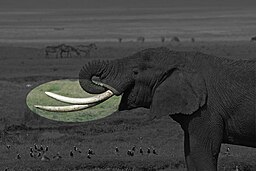
The incisor teeth of elephants are used to dig for food like roots, or in stripping barks to get the edible phloem. In dry season, elephants use their tusks to dig the ground to get water or even make a well where other animals can also drink. Tusks are also the elephants armor in defending themselves when fighting or in protecting their young from predators.
However, tusks are desired for the beauty it exudes after being carved into objects like art pieces or accessories. The demand drive poachers to kill elephants without mercy and in total disregard for the elephants’ lives or their specie’s survival in the world.
Schuyler Shepherd, CC BY 2.5 h https://upload.wikimedia.org/wikipedia/commons/8/8f/Tanzanian_Elephant_tusks_highlighted.jpg

IUCN (International Union for Conservation of Nature) Red List
SPECIES of ELEPHANT | POPULATION (2024) | CONSERVATION STATUS per IUCN |
|---|---|---|
| African Savanna | 300,000 | Endangered |
| African Forest | 100,000 | Critically Endangered |
| Indian | 20,000 | Endangered |
| Sri Lankan | 7,000 | Endangered |
| Sumatran | 1,500 | Critically Endangered |
| Bornean | 1,000 | Endangered |